
*ME5 - Determination of r+n value
โพสต์เมื่อ : 30 ก.ย 2568 เวลา 7:20 น.

ME5 module - Determination of r + n value
Take your testing to the next level – available as an add-on module
Description
Tensile test for metallic materials Part 1
Test method at room temperature
Determination of offset yield stresses, apparent yielding points, tensile strength, breaking force including the pertinent extensions and the E module as well as reduction in area when breaking in the tensile test to DIN EN ISO 6892-1.
Test control is possible with 2 different methods.
- Method A - Elongation controlled, controlled via signal of extensometer
- Method B - Load controlled (stress controlled)
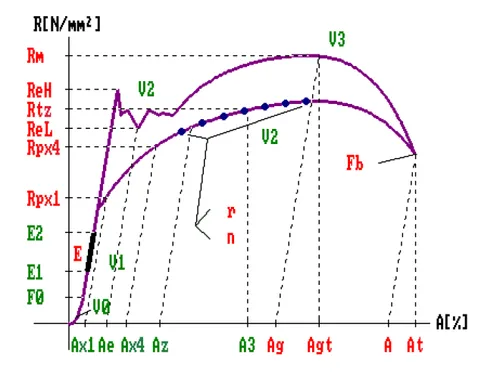
Basic Results
- mE: Tensile modulus
- Rpx1: Yield strength at non-proportional strain Ax1
- Rpx3: Yield strength at non-proportional strain Ax4
- Fpx1: Load at non-proportional strain Ax1
- Fpx4: Load at non-proportional strain Ax4
- Rtz: Stress at total elongation Az
- Ftz: Load at total elongation Az
- ReH: Upper yield strength
- ReL: Lower yield strength
- Rm: Tensile strength (tensile stress at maximum test load )
- Fm: Maximum test load
- Fb: Breaking load
- Ae: Apparent yielding point extension
- Ag: Non-proportional extension at maximum force
- A: Breaking extension
- Agt: Overall extension at maximum force
- At: Overall extension at sample break
- Z: Reduction in area when breaking
- FeH: Load at upper yield strength
- FeL: Load at lower yield strength
- Rp0.0: Yield strength at initial-proportional strain
- Fp0.0: Load at initial-proportional strain
- Re/ReH: Yield strength ratio
- Rm/RP0.2: Yield strength ratio
- r: r-value indicates the vertical anisotropy
- n: n-value indicates material work hardening under plastic deformation
- etc.
> Download <
ME5 Manual